

Fan Investors
September 26, 2026
Master vs Publishing Rights: Music Rights Explained
Read more
Explore how to invest in music royalties, how royalty income is generated, what makes one opportunity stronger than another, and what investors should check before committing capital.


Music royalties are becoming easier for individual investors to access while the underlying music market continues to grow. Global recorded music revenue reached $31.7 billion in 2025, but the opportunity still comes down to the economics of each individual royalty stream.
A strong recent year may include a viral moment, major sync placement or another temporary boost. Comparing LTM income with several years of history helps reveal whether recent earnings are normal, growing or unusually inflated.
No. A low multiple can reflect declining income, a shorter investment term or greater uncertainty. The multiple only becomes meaningful when considered alongside the quality, stability and expected durability of the royalty stream.
No. Regulation A qualification allows the offering to proceed, but it is not an SEC recommendation or endorsement. Investors still need to review the Offering Circular, understand the specific rights and consider the risks before investing.
Music royalties have become an established part of the alternative-investment landscape. What was once a market dominated by record labels, publishers, specialist funds, and institutional catalog buyers is increasingly accessible to individual investors as well.
There’s been an outpouring of investments in music royalties. Larger companies are moving into the music royalty space. For example, Justin Timberlake sold the rights to his song catalog to Hipgnosis Songs Capital in a deal worth $100 million. Bruce Springsteen sold his music rights for over $500 million to Sony Music Group. And companies like Kobalt and Primary Wave are also acquiring catalogs.
The underlying attraction is relatively straightforward: music can continue generating income long after its original release through streaming, radio, public performance, licensing, downloads, and other uses. Investors who acquire an interest in those royalty streams can participate in a portion of that future income.
So how does investing in royalties actually work? And what should you look at before putting money into a song or music catalog?
Investing in royalties means purchasing the right to receive some or all of the future income generated by an existing royalty-producing asset.
In music industry, that means acquiring participation in the revenue generated when songs are streamed, played on the radio, performed publicly, downloaded, licensed for films or advertising, or otherwise commercially used.
Importantly, investing in music royalties does not necessarily mean purchasing the copyright to an entire song. An investor may instead acquire an interest in a specific royalty stream—for example, a songwriter's performance royalties, publishing income, master royalties, or another defined contractual interest.
The basic investment model is straightforward: you invest capital today in exchange for the right to receive a portion of future royalty income.
What makes royalty investing more complex is determining what that future income may be worth. Before investing, you need to understand the rights included in the transaction, the asset's historical royalty payments, how those payments are trending, the duration of the royalty interest, the price being paid, and the risks that could cause future income to decline.
Music royalties are particularly interesting because established songs and catalogs may have years of historical royalty data that investors can analyze before making a decision.
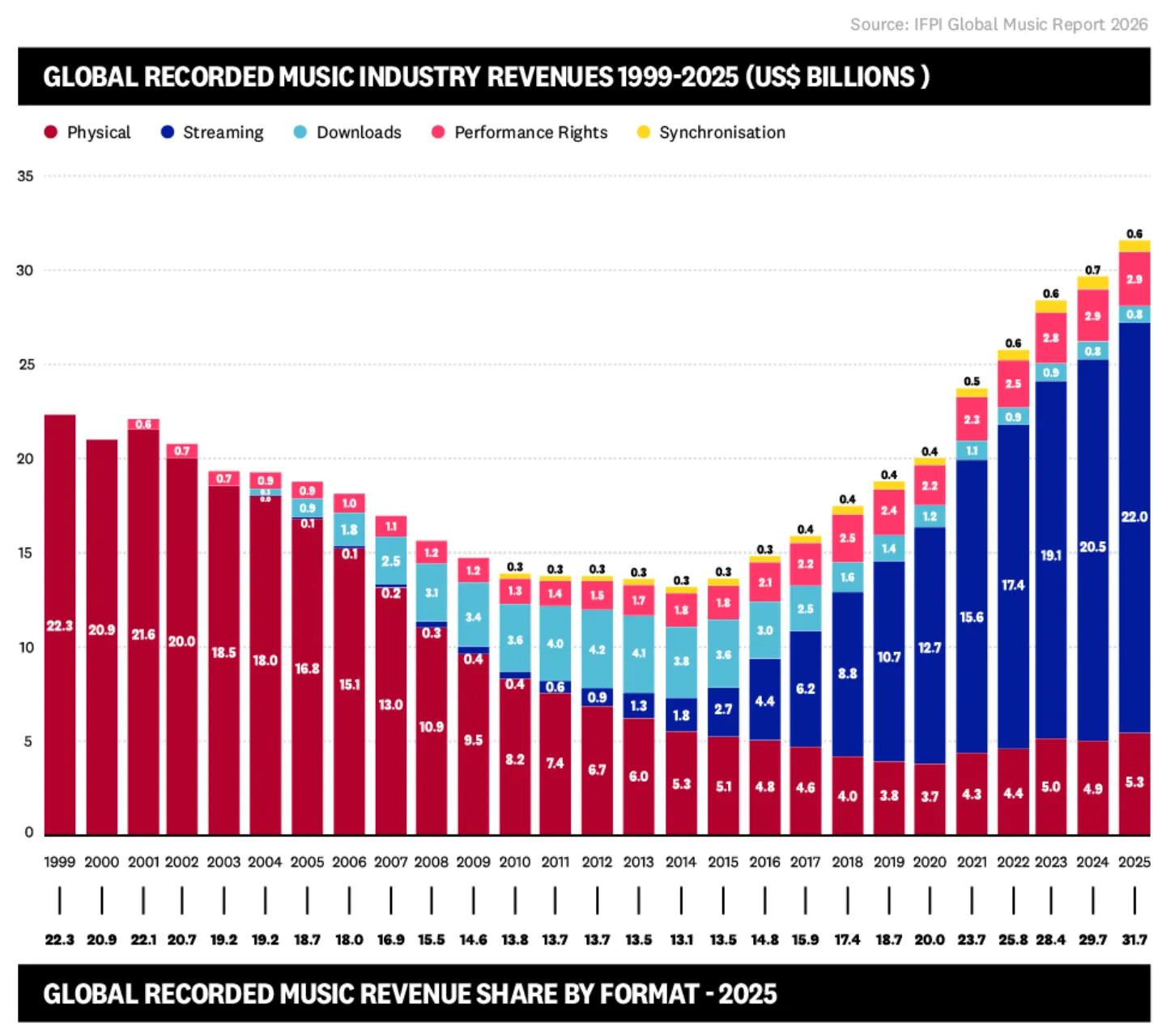
Overall, music royalties took a dip in the mid-2000s. Spotify initially opened its doors in 2008, but didn’t launch in markets like the United States until 2011. However, it wasn’t until 2015 when streaming royalties — along with a global rebound in the overall music market — really took off.
Acceleration of streaming continues to increase with time. Streaming represents 65% of the global revenue share and there is a 21.9% growth in paid streaming services. It’s not just that streaming is growing; streaming is adding to the pie year over year.The global recorded music market has continued to expand. According to IFPI's Global Music Report 2026, worldwide recorded music revenues reached $31.7 billion in 2025, up 6.4% year over year and marking the industry's eleventh consecutive year of growth. Paid subscription streaming revenue increased 8.8% and accounted for 52.4% of global recorded music revenue, with 837 million users of paid subscription accounts worldwide.
The US remains particularly important for music investors. RIAA reported that US wholesale recorded music revenue reached a record $11.5 billion in 2025. Streaming generated $9.5 billion, while paid subscriptions reached 106.5 million accounts and generated $6.4 billion.
None of this guarantees that an individual song or catalog will increase its royalty income. But it shows that music royalties sit inside a large and still-growing commercial ecosystem in which streaming has become the dominant source of recorded music revenue.
The longer-term outlook also remains positive. Goldman Sachs Research forecasts the broader global music industry (including recorded music, publishing and live music) to grow from approximately $105 billion in 2024 to nearly $200 billion by 2035. Forecasts are inherently uncertain, but continued expansion of the wider music economy provides useful context for investors assessing the long-term market for music rights.
Music royalties have characteristics that differ from many traditional investments. The underlying cash flow is generated by the continued consumption and commercial use of music (through streaming, radio, performance, licensing and other sources) rather than directly by the earnings or share price of a single operating company.
That does not mean music royalties are immune to economic conditions, nor does it guarantee diversification benefits. Individual royalty streams can rise or fall as listener behavior changes, songs age, licensing activity fluctuates, royalty rates change or particular revenue sources become more or less important.
What has changed considerably is investor access. Music rights were historically concentrated among artists, publishers, labels and specialist buyers. Today, royalty marketplaces and fractional structures have made certain music royalty streams accessible to a broader range of investors.
Institutional interest has also continued to develop. In May 2026, KBRA reported that it had rated approximately $12.9 billion of music royalty asset-backed securities across 18 issuers since 2020, including more than $3.3 billion of issuance in both 2024 and 2025.
For individual investors, however, the size of the wider market is less important than the economics of the specific royalty stream being considered. The rights being purchased, historical income, revenue trend, term and valuation all matter when determining whether a particular opportunity is attractive.

There are several recipients of music royalties, including the songwriter (which can often be the recording artist). The songwriter often writes a song and partners with a publisher to publish or admin the songwriter’s catalog. A record label may be involved because they release the recorded music of the song to the general public and monetize it on streaming services, paid download services, and other channels. And then there is the artist who performs the song on the master recording.
All four of these recipients represent buckets we can package and sell on SongVest.
Music royalties can come from a variety of different sources. There are:
Different organizations can pay these royalties; and these royalties can be packaged and sold.
Before investing in music royalties, it is important to understand that a song generally involves two separate copyrights.
The composition covers the underlying music and lyrics. Rights in the composition are generally associated with songwriters and music publishers.
The sound recording, commonly called the master, covers a particular recorded performance of that composition. Master rights may be owned by a record label, artist, or another rights holder depending on the contractual arrangement.
This distinction matters because investing in a royalty stream connected to a song does not necessarily mean participating in every dollar that song generates. An offering could involve a songwriter's share of performance royalties, publishing income, master royalties, producer royalties, or another defined interest.
Before investing, determine exactly which rights are being offered and which sources of royalty income those rights generate.
SongShares are SongVest’s way of giving investors access to royalty participation connected to individual songs and music assets. Each offering has its own structure, royalty rights and terms.
For a detailed explanation of how SongShares work, what investors receive and how royalty participation is structured, read our complete guide to SongShares.
SongShares are issued as Royalty Share Units. A Royalty Share Unit gives the investor a contractual right to receive a proportional share of the cash flow generated under a specific Royalty Share Agreement, after applicable administrative fees. Purchasing Royalty Share Units does not give the investor ownership in SongVest or ownership of the underlying music portfolio itself.
Each SongShare offering relates to a specific Music Royalty Asset and has its own terms. The duration of the investment follows the term of the underlying Royalty Share Agreement, so investors should review the relevant listing and Offering Circular rather than assuming that every SongShare runs for the life of the copyright.
SongShare offerings are made under Regulation A and must be qualified before SongVest accepts investment funds for the applicable offering. SEC qualification should not be interpreted as a recommendation or endorsement of the investment. Investors should review the Offering Circular and associated risk disclosures before investing.
Liquidity is an important consideration when investing in music royalties. Unlike publicly traded stocks, SongVest currently does not offer a secondary market for SongShares, so investors should not purchase them on the assumption that they can immediately sell their position if they need access to their capital.
Before investing, consider the stated duration of the royalty stream and whether you are comfortable holding the investment without relying on a near-term resale opportunity.
There are several steps to launching a SongShare with SongVest.
SongVest performs an analysis on the royalty streams for the song or the catalog. SongVest reviews at least three years of historical royalty statements and verifies the royalty stream. SongVest then works with the rights holder to determine the structure of the proposed sale and appropriate pricing parameters. Once the rights holder decides what they want to sell their catalog for, SongVest can go straight to purchase or offer a VIP auction. A royalty agreement is signed.
SongVest may use a VIP Auction as a price-discovery process before an offering is qualified. Investors indicate how many Royalty Share Units they would be interested in purchasing at different prices. These bids are non-binding indications of interest rather than completed investments. The auction helps SongVest gauge investor demand and inform the eventual offering price, although SongVest retains ultimate discretion over the final price.
After the price-discovery process, SongVest finalizes the applicable offering materials and seeks qualification of the offering under Regulation A. No investment funds are accepted before qualification.
VIP Auction bidders with successful bids have the first opportunity to purchase up to the number of SongShares included in their winning bid before remaining units are offered to the general public.
SongVest collects royalty payments from the applicable royalty streams and distributes the resulting amounts to investors according to the distribution schedule described for the offering. Because underlying royalty payers may report and pay on different schedules, investors should review the applicable listing and Offering Circular for the timing that applies to their SongShares.
What are some questions SongVest asks when evaluating a catalog? SongVest generally reviews the following aspects:
Type of rights often include writer’s share, publishing, master, et al. SongVest still offers catalogs via a normal auction where investors purchase 100% of that asset. In this case, SongVest isn’t splitting the asset up into a security at all. The first question is: As an investor, what right am I buying?
An investor might only be buying the performance rights, writer’s share, mechanicals, or others. For example, it’s possible investors are buying the writer’s share and only one of these types of income.
Depending on the rights involved, royalty payments may come from a performing rights organization, record label, distributor, publisher, administrator or another royalty-paying entity. For example, a writer's share of public-performance royalties might be paid through a performing rights organization, while income associated with a master recording could be reported and paid through a label or distributor.
The payer should be identifiable in the historical royalty statements and supporting documentation. SongVest requires sellers to identify the entity paying the royalties and provide historical royalty statements so that the underlying stream can be reviewed and verified.
Check how long you are entitled to receive the royalty income. Terms can vary by offering, so use the specific duration stated in the listing and offering documents rather than assuming every investment lasts for the life of the copyright.
The last twelve months, or LTM, provide a recent snapshot of how much income the royalty interest generated. Compare this with earlier years to determine whether the latest period looks typical or was affected by an unusual spike or decline.
Look at several years of royalty data to see whether income is generally increasing, stable or declining. A single year can be misleading, so the longer-term direction often tells you more about the durability of the income stream.
Look at the mix of streaming, performance, mechanical, sync and other royalty sources. A stream supported by several recurring sources may behave differently from one that depends heavily on a single platform or one-time licensing event.
Before a royalty stream is listed, SongVest reviews historical royalty statements and supporting information relating to the rights being offered. Sellers are required to identify the entity paying the royalties and provide historical statements so that the income stream can be reviewed and verified.
Where the available statements contain track-level or source-level detail, that information can also help identify which songs and royalty sources are driving the catalog's earnings.
Historical royalty statements are the primary financial evidence. External music-market data can then provide an additional cross-check on how the underlying songs are performing.
SongVest may also cross-reference royalty performance with external music-market data. Tools such as Chartmetric provide track-level signals including streaming activity, playlist exposure, social activity and radio airplay. These signals can help provide additional context around a song's performance, but they should be treated as a cross-check rather than a substitute for the underlying royalty statements.
Catalogs are generally priced via a multiple, a metric used to price music royalties and catalog assets. A multiple simply means reviewing the last twelve months of data and assigning a multiple to it. The result is the valuation of the asset.
For example, if the royalties of an asset over the last twelve months are $10,000 and the multiple is 10x, then the valuation is $100,000.
There is no universal “correct” multiple for music royalties. The multiple investors are willing to pay can vary substantially depending on the age of the catalog, historical income stability, revenue mix, recent trend, rights included, investment term and size of the transaction.
A lower multiple therefore does not automatically mean an asset is undervalued, just as a higher multiple does not automatically mean it is overpriced. The multiple needs to be considered alongside the quality and expected durability of the underlying royalty income.
This is an implied trailing gross yield based on historical royalties before applicable fees, taxes or changes in future royalty income. It is not a forecast or guaranteed return. If future royalties decline, the realized income yield will decline as well.
Like any investment, music royalties involve risk. Historical royalty payments can help investors understand how a song or catalog has performed in the past, but they do not guarantee that the same level of income will continue in the future.
Before investing, consider not only how much an asset has earned, but also what could cause those earnings to change.
Songs do not necessarily generate the same amount of money every year. Streaming activity can fall, radio play can decrease, licensing demand can change, and listeners may simply move on to other music.
This is why several years of royalty history are usually more informative than a single strong year. A gradual decline may still produce attractive income at the right valuation, but that decline should be reflected in the price an investor is willing to pay.
The last twelve months of royalty income can occasionally make an asset look stronger than its normal performance.
A song might receive a major synchronization placement, experience a viral moment, appear in a popular television series, or benefit from another event that causes royalties to jump temporarily.
Investors should therefore look at what caused recent earnings and ask whether those sources of income are likely to repeat. A one-time increase should not automatically be treated as recurring annual revenue.
Investing in a song does not necessarily mean participating in every royalty that song generates.
An investment might include publishing royalties, a writer's share, master royalties, mechanical income or another specific interest. If the investment only covers one particular royalty stream, income generated elsewhere may not benefit the investor.
Understanding exactly which rights are included is therefore one of the most important parts of evaluating a music royalty investment.
SongShares also depend on the contractual and administrative structure through which royalties are collected and distributed. Royalty Share Units are unsecured obligations of SongVest, so investors should review the applicable Offering Circular and understand the risks associated with the issuer as well as the underlying music royalty stream.
Even a popular song can be a poor investment if the price is too high.
A royalty stream generating $10,000 per year may look attractive at one valuation and much less attractive at another. Investors need to consider the multiple being paid alongside the stability, trend and expected duration of the royalty income.
A high historical yield should not automatically be interpreted as a bargain either. A lower valuation may reflect declining income, a shorter term or greater uncertainty around the asset.
Buying a royalty interest in one song gives you concentrated exposure to the performance of that particular asset.
If the song's royalty income falls, there are no other songs within that individual investment to offset the decline. Investors who want broader exposure may therefore choose to spread their royalty investments across multiple songs, artists, genres or types of royalty income.
Diversification cannot eliminate losses, but it can reduce reliance on the performance of one individual asset.
Music royalty investments should not automatically be treated like publicly traded stocks that can be sold at any time.
The ability to exit an investment depends on the structure of the particular offering and whether a market exists for reselling it. As discussed earlier in this guide, SongShares cannot currently be sold through a SongVest secondary market.
Investors should therefore consider whether they are comfortable holding the investment for its stated term rather than relying on the ability to sell it quickly.
Royalty distributions are based on the actual income generated by the underlying rights, so payments can vary from one period to another.
There may also be a delay between when a song is streamed, performed or licensed and when the corresponding royalties are reported, collected and eventually distributed.
For that reason, music royalties should not be viewed in the same way as an investment that promises a fixed interest payment on a predetermined schedule.
The purpose of analyzing these risks is not to suggest that music royalties are inherently unattractive. It is to make sure the price you pay reflects the uncertainty of the future cash flow.
A strong royalty investment is not simply a popular song or an asset with a high historical yield. It is one where the rights, historical income, revenue trend, term, valuation and risks make sense together.
Music royalties have become more accessible to individual investors, but accessibility does not remove the need for careful analysis. Before investing, understand the rights you are purchasing, examine several years of royalty history, consider the duration and liquidity of the investment, and compare the purchase price with the income the royalty stream has historically produced.
Platforms such as SongVest make it possible to participate in individual royalty streams without purchasing an entire catalog. For investors interested in alternative assets (and in the economics behind the music they already listen to) that opens a market that historically was difficult for individuals to access.
We are always happy to help rights holders, artists, fans, and investors understand the marketplace. If you have any questions, get in touch with our team. And, if you are interested in bidding on music royalty auctions, you can create a SongVest account for free.
If you are a rights holder or an artist and would like your music royalties evaluated, please request a free evaluation here.
How do I invest in music royalties?
You can invest in music royalties by purchasing royalty interests directly from rights holders, buying through a specialist royalty marketplace, or participating in fractional royalty offerings. The structure varies by platform and asset, so always identify exactly which royalty rights you are purchasing, examine historical income and understand the term and liquidity before investing.
Can I sell a music royalty investment later?
That depends entirely on the investment. Some royalty marketplaces provide resale mechanisms, while other investments may be highly illiquid. SongVest currently states that it does not offer a secondary market for SongShares, so investors should be prepared to hold them rather than assume they can sell whenever they choose.
Are music royalties a good investment?
Music royalties can be attractive to investors looking for exposure to an alternative source of income, but there is no such thing as a universally “good” royalty investment. The quality of an opportunity depends on the rights being purchased, historical and expected royalty income, price, term, revenue concentration and liquidity. A strong song can still be a poor investment if the price is too high.
Are music royalty investments safe?
Music royalties involve investment risk. Future royalty payments can decline, an investment may be illiquid, and historical earnings do not guarantee future results. SongVest's current SEC filings explicitly state that there is no expected rate of return for Royalty Share Units because royalty payments are variable.
What do I actually own when I invest in music royalties?
It depends on the investment structure. With SongVest Royalty Share Units, investors receive a contractual right to a proportional share of the royalty cash flow associated with the applicable Royalty Share Agreement. The units do not give investors ownership in SongVest or ownership of the underlying music portfolio itself.
How do music royalty investors make money?
Music royalty investors can receive distributions when the underlying royalty interest generates income. Depending on the rights included, that income can ultimately come from sources such as streaming, public performance, downloads, mechanical royalties, synchronization licensing and other commercial uses. The exact revenue sources differ from one royalty investment to another.
How often are music royalty investors paid?
Payment timing depends on the underlying royalty stream and investment structure. Different royalty payers can report and remit income on different schedules, so investors should review the applicable offering documents rather than assuming every royalty investment follows the same payment cycle. SongVest's current SEC offering materials contemplate quarterly distributions of royalties received during the relevant calendar quarter.
Can music royalty payments go down?
Yes. A song can generate less income as listening activity, radio play, licensing or other uses change. One-time events such as a major sync placement or viral resurgence can also temporarily increase royalty income. That is why investors should compare the most recent twelve months with several years of historical data instead of assuming last year's royalties will repeat.
How long does a music royalty investment last?
The investment term depends on the specific rights and contract. Some royalty interests can run for decades, while others have shorter defined terms. SongVest states that each listing specifies the length of the applicable royalty stream, and its SEC filings say the term of Royalty Share Units follows the underlying Royalty Share Agreement.
Do music royalties last for the life of the copyright?
Sometimes, but not necessarily. A royalty interest can be sold for a defined contractual period that ends before the underlying copyright expires. Even copyright duration itself varies depending on factors such as authorship, creation date and whether the work was made for hire. Investors should therefore look at the investment's stated term rather than assuming “life of copyright.”
How much money do I need to invest in music royalties?
The minimum depends on the type of transaction and the specific offering. Buying an entire royalty stream directly can require substantial capital, while fractional offerings allow investors to participate with smaller amounts. For SongShares, the relevant unit price is stated for the particular offering rather than being fixed at one universal price. Current 2026 SongVest filings show materially different unit prices across offerings.
What is the difference between publishing royalties and master royalties?
Publishing rights relate to the underlying musical composition (the music and lyrics) while master rights relate to a particular sound recording. Because these are separate copyrights, different people or companies can own them and participate in different royalty streams. An investor should therefore determine whether an offering relates to publishing, master rights or another specific royalty interest before buying.
How are music royalty investments valued?
One common starting point is the royalty multiple, which compares the purchase price with the royalties generated during the previous twelve months. For example, an asset earning $10,000 in LTM royalties and priced at $80,000 has an 8x multiple. Valuation should also consider the income trend, age of the catalog, revenue mix, term and stability of historical earnings. Current marketplace analysis uses those factors alongside multiples and discounted cash-flow analysis.
Who pays music royalties to investors?
The original royalty income can come through different payers depending on the rights involved. These can include performing rights organizations, labels, distributors, publishers, administrators and other royalty-paying entities. In a SongVest structure, the relevant royalties flow to SongVest under the applicable Royalty Share Agreement and are then distributed proportionally to Royalty Share Unit holders according to the offering terms.

Invest in Hit Songs.