Fan Investors
November 2, 2026
Guide to Music Memorabilia: Collecting, Value & More
Read more
From signed records to stage-used guitars, learn how music memorabilia is valued, authenticated, collected and preserved.

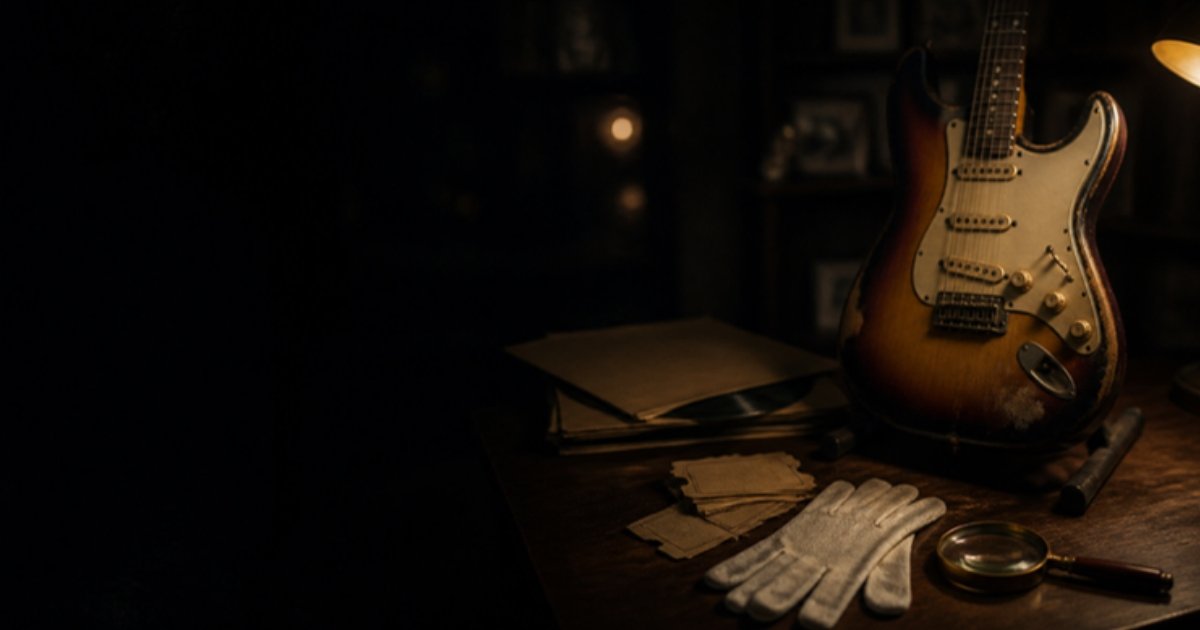
Music memorabilia includes collectible items connected to musicians, bands, recordings, concerts, tours, or important moments in music history. Examples include signed records, concert posters, tickets, handwritten lyrics, stage-worn clothing, instruments, rare vinyl, awards, and backstage items. This guide to music memorabilia explains how you can collect, authenticate, value, buy, sell, and preserve these items with more confidence.
There is a big difference between owning a copy of an album and owning something that played a part in its story. A ticket can bring you back to one unforgettable concert, while a handwritten lyric sheet can show you how a song took shape before you ever heard the finished version. Collecting also comes with risks because a high asking price does not prove value, and a certificate does not automatically prove authenticity.
By understanding provenance, condition, rarity, market value, and authentication, you can make better collecting decisions while discovering new ways to connect with the music you love through SongVest.
Music memorabilia is any collectible object with a meaningful connection to a musician, band, recording, performance, tour, or part of music history. That connection matters because two objects that look almost identical can have completely different stories and values.
For example, an ordinary guitar is an instrument. A guitar once owned by a famous musician becomes memorabilia, while one you can document as being used to record an important album may belong in another category altogether.
Music memorabilia also differs from ordinary merchandise. A new tour shirt bought at a merch stand is merchandise. Over time, it may become collectible because of its rarity, age, design, or connection to a specific tour, but a stage-worn version documented to a particular performance has a much stronger link to the artist.
At the high end of the market, that connection can translate into extraordinary prices. In March 2026, Christie's auction results showed that the Jim Irsay Collection generated $94,484,903, which Christie's described as the largest total for a memorabilia auction in its history. David Gilmour's Black Strat alone sold for $14.55 million.
You do not need a museum-level budget to start collecting. Music collectibles exist at many price points, and understanding exactly what you are buying matters far more than simply chasing expensive items.
You can collect almost any object with a genuine connection to an artist, recording, concert, or music scene. Common categories include:
These terms overlap, but they are not identical.
Merchandise is generally produced for fans to buy, such as tour shirts, posters, pins, or programs. A collectible is something people deliberately seek and keep because of its scarcity, design, history, or personal meaning.
Memorabilia usually carries a more direct connection to a musician, recording, event, or moment in music history. That link might come from artist use, an autograph, a specific concert, or documented ownership.
A mass-produced tour shirt can become collectible over time. The same design worn onstage by the artist, with evidence connecting it to a particular performance, becomes a very different object.
Autographed music memorabilia offers an accessible way to start collecting, but signatures are also one of the areas where you need to be especially careful.
Do not ask only whether a signature looks real. Ask what was signed, who signed it, when it was signed, and what evidence supports its authenticity.
The item itself also matters. A generic signed photograph and an original copy of an important album signed during its release period can both be authentic, but collectors may value them very differently.
Artist-owned instruments and clothing can create a direct physical link to a musician, but ownership does not automatically prove important use.
Look for evidence connecting the exact object to a recording, tour, concert, music video, or another documented event. Photographs, video footage, serial numbers, repair records, wardrobe notes, and previous auction records can all strengthen that connection.
Handwritten lyrics can reveal the creative process through crossed-out words, alternate lines, unfinished ideas, or notes that never appeared in the final song.
Setlists, tickets, posters, tour programs, backstage passes, and other concert memorabilia can document a specific night or period in an artist's career.
Originality matters. A poster printed to advertise a concert decades ago is not the same collectible as a modern reproduction using the same artwork.
Rare vinyl may become collectible because of an early pressing, withdrawn cover, promotional release, limited run, misprint, or another identifiable variation rather than age alone.
Awards, press kits, promo records, and industry materials can also attract collectors when you can verify their origin. Labels, matrix numbers, packaging, issue dates, recipients, and supporting documents can help you distinguish a common item from a genuinely scarce version.
If you are new to the hobby, a practical guide to music memorabilia should help you narrow your focus rather than encourage you to buy anything labeled "rare."
When you start collecting music memorabilia, use a simple process:
A focused collection helps you learn faster. If you repeatedly study one artist, poster style, record label, or era, you start to recognize what is common, what stands out, and what looks suspicious.
Your budget should also include more than the purchase price. Auction premiums, shipping, authentication, insurance, framing, storage, and conservation can increase what an item ultimately costs you.
If you collect vintage music memorabilia or rock memorabilia, learning the printing methods, labels, materials, and designs used during the relevant period can help you identify later reproductions.
Document each purchase from the beginning. Keep seller details, dates, receipts, photographs, certificates, provenance records, serial numbers, and previous auction listings whenever they are available.
Music memorabilia authentication depends on the type of object you are examining. You should separate what you can verify from what a seller simply tells you.
Provenance is the documented history of an object.
Imagine someone offers you an old guitar and says a famous musician once played it. Without supporting evidence, you have an old guitar and an interesting story.
Now imagine that you also have period photographs showing the musician holding that exact instrument, serial numbers, repair records, correspondence explaining how it changed hands, and a documented auction history. You now have a much stronger connection.
Useful provenance can include:
The best provenance is not simply exciting. You can verify it.
Professional authentication services use more than visual guesswork.
PSA authentication explains that its autograph review can include ink analysis, autograph structure analysis, object evaluation, and comparison with known examples. Certified items can also be checked through its verification database.
Beckett authentication provides third-party autograph authentication and certification, including examination by authentication specialists.
Not every signed object requires third-party authentication. The level of verification should make sense for the value of the item, the available provenance, and the risk involved.
A Certificate of Authenticity, or COA, does not automatically prove that an autograph is genuine.
Anyone can create a certificate. What matters is who issued it, how the item was examined, whether the certification can be independently checked, and whether the authenticator has a credible history.
A Letter of Authenticity, or LOA, may contain more information about the item and the authentication opinion, but the same principle applies. The credibility of the issuer matters more than the title printed on the document.
Several warning signs should make you slow down:
If you want authentic music memorabilia, you should be able to understand why an item is believed to be genuine rather than relying entirely on the seller's description.
A useful guide to music memorabilia should make one point clear: age alone does not determine value.
Collectors generally look at several factors together:
No single factor guarantees a high price.
A rare object with weak provenance may still be difficult to sell. Likewise, an item connected to a famous artist can remain relatively affordable if many similar examples exist.
Condition also needs context. Genuine stage wear can form part of an item's history, while mold, fading, careless repairs, missing pieces, or later damage may simply reduce its appeal.
Start by identifying the object as precisely as possible.
With vinyl, that may mean checking the pressing, record label, matrix numbers, country, sleeve, artwork, and condition. With a poster, you may need to establish the printing date and whether it is an original or later reproduction.
Then look for comparable completed sales.
An asking price tells you what a seller hopes to receive. A completed sale shows what a buyer actually paid.
If three comparable authenticated records recently sold for $1,500, $1,800, and $2,100, another seller listing one for $8,000 does not automatically make it an $8,000 collectible.
Compare the artist, item type, era, condition, signatures, provenance, authentication, historical connection, and sale date.
For unusual or high-value objects, a professional music memorabilia appraisal may be worthwhile, especially when you need a value for insurance, estate planning, or a future sale.
Whether you are buying or selling, strong documentation reduces uncertainty.
When you find music memorabilia for sale, check the object and the seller before you focus on the price.
Use this checklist:
Do not let excitement replace due diligence. If the story sounds unusually good, spend more time proving it.
Gather your receipts, certificates, photographs, previous auction records, and other provenance before you approach buyers.
Then choose a selling method that matches the object. A modest signed record may suit a specialist marketplace, while a historically important instrument may benefit from an established auction house with experience handling similar material.
Your description should explain what you know without overstating it.
Include:
Use descriptions such as "rare," "original," "stage-used," or "artist-owned" only when the evidence supports them.
Protecting a collection matters because light, moisture, poor storage materials, and careless restoration can permanently damage an item.
The Library of Congress recommends keeping works on paper in a cool, relatively dry, clean, stable environment with minimal light exposure. It also advises against self-adhesive tape and glue and recommends suitable protective enclosures for long-term preservation.
For records, use sleeves designed for the format and store them upright in a stable environment away from direct sunlight, excessive heat, and moisture.
Light damage builds gradually and may not be reversible.
The National Archives recommends limiting light exposure for original papers and photographs and using ultraviolet-filtering glazing when displaying originals.
For especially fragile or valuable objects, you can display a high-quality reproduction while storing the original under safer conditions.
Do not assume that cleaning, repairing, refinishing, or mounting an old collectible will automatically improve it.
You may accidentally remove original material or change characteristics that help establish the object's history.
If an expensive or historically important item needs treatment, the American Institute for Conservation provides a conservator directory where you can search for qualified professionals.
Just as importantly, preserve the paperwork. Keep receipts, certificates, photographs, correspondence, appraisals, and previous auction records with the collection.
Some music memorabilia has increased dramatically in price, but no category consistently appreciates.
Collector demand changes. Markets can be illiquid. Selling may involve commissions and other costs. Authenticity questions or poor condition can also reduce what somebody is willing to pay.
You should therefore avoid treating a signed album, ticket, poster, or instrument as guaranteed appreciation.
If you genuinely value an object, you can still enjoy owning it even if its resale price never increases.
Physical memorabilia is no longer the only way you can build a closer connection with music.
Traditionally, you could buy a record, frame a poster, collect a tour shirt, or own an autograph, while the financial rights connected to the music generally remained with artists, songwriters, publishers, labels, producers, and other rightsholders.
New models have started to broaden that idea.
SongVest's How It Works page explains that SongShares® give eligible buyers fractional participation in specified music royalty streams rather than ownership of the entire master recording or publishing copyright.
Each offering has its own rights, terms, royalty sources, and risks. You should therefore review the specific offering documents and relevant buyer questions before deciding whether an offering is appropriate for you.
SongVest offers SongShares through Tier 2 Regulation A offerings. The SEC Regulation A guidance explains how Regulation A operates and outlines the requirements that apply to Tier 1 and Tier 2 offerings.
A SongShare is therefore different from a signed record or concert poster. A traditional collectible connects you to an object associated with music history, while a SongShare can provide contractual participation in a defined royalty stream, subject to the specific offering terms.
The best collection does not need to contain the world's most expensive guitar. It should reflect music you care about while giving you enough knowledge to recognize authenticity, provenance, value, condition, and risk.
Use this guide to music memorabilia as a framework, but let your own taste decide what deserves a place in your collection. If you also want to explore another form of music participation, you can browse current SongShares and learn more about music ownership through SongVest.
Music memorabilia includes collectible objects connected to musicians, bands, recordings, performances, tours, or music history. Examples include signed albums, posters, tickets, instruments, handwritten lyrics, stage-worn clothing, photographs, backstage passes, awards, and rare records.
You can assess music memorabilia by looking at authenticity, provenance, rarity, condition, historical significance, collector demand, and comparable completed sales. Actual sale results usually provide better market evidence than unusually high online asking prices.
No type of music memorabilia consistently increases in value. Rare or unique items with strong provenance and a direct connection to an important artist, recording, or performance have produced some of the strongest auction results.
Music memorabilia can rise in value, but you should not treat appreciation as predictable or guaranteed. Collector tastes, liquidity, authenticity, condition, provenance, and market demand can all affect what you eventually receive if you sell.
Review the item's provenance and use a reputable independent authentication service when appropriate. You should also verify certification numbers directly and compare the seller's claims with the available documentation.
A COA does not prove authenticity by itself because its reliability depends on who issued it and how the item was examined. Check the reputation of the authenticator and whether you can independently verify the certificate.
Value often depends on authenticity, provenance, scarcity, condition, historical importance, artist demand, and comparable sales. A direct and well-documented connection to a major recording, tour, concert, or moment in music history can increase collector interest.
Some signed records can be valuable, but a signature alone does not determine price. The artist, album, authenticity, number of signatures, pressing, condition, provenance, and timing of the signatures can all matter.
Some old tickets have collector value, particularly when they come from important concerts, early appearances, farewell shows, historic festivals, or famous tours. Common tickets from less notable events may remain inexpensive even when they are decades old.
Original concert posters can attract strong demand when they relate to important artists, venues, designers, or performances. Rarity, condition, provenance, print history, and whether the poster is truly original can all affect value.
Handwritten lyrics can be highly collectible, especially when they are original working drafts from an important song. Lyrics written out by an artist years later may still be authentic, but they have a different historical connection from a manuscript created during songwriting.
Auction records change over time, but David Gilmour's Black Strat sold for $14.55 million at Christie's in March 2026 and set an auction record for a guitar at that time. Other music-related objects have also reached multimillion-dollar prices, so you should check current auction records when comparing major sales.
Be cautious because amateur restoration can permanently alter an original item and may affect its collector value. For expensive or historically important objects, consult an experienced conservation professional before making irreversible repairs or changes.
Keep sensitive items away from direct sunlight, excessive moisture, heat, and unstable environmental conditions, and use preservation-quality materials suited to the object. You should also keep certificates, photographs, receipts, and provenance records with the collection.
SongVest offers SongShares that combine a collectible concept with fractional participation in defined music royalty streams. These are securities with offering-specific terms and risks, not guaranteed-income collectibles.
No, a SongShare generally gives you contractual participation in a defined royalty stream rather than ownership of the master recording or publishing copyright. You should read the relevant offering documents because each SongShare can cover different rights, terms, and royalty sources.

Invest in Hit Songs.