Fan Investors
October 2, 2026
15 Most Iconic Band T-Shirts of All Time
Read more
Explore the best band T-shirts ever made and the stories behind famous designs from Nirvana, Pink Floyd, the Rolling Stones, Ramones and more.

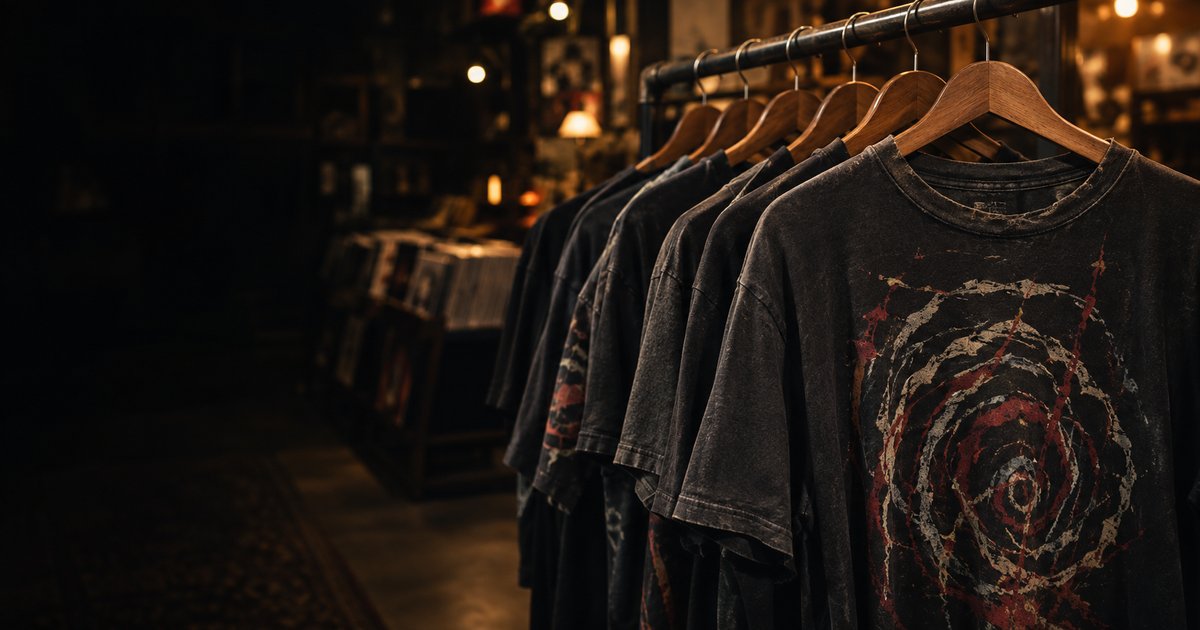
The most iconic band T-shirts of all time include the Rolling Stones Tongue and Lips logo, Pink Floyd’s The Dark Side of the Moon prism, Nirvana’s smiley face, the Ramones presidential seal, Joy Division’s Unknown Pleasures waveform, the Grateful Dead’s Steal Your Face skull, Run-DMC’s red-bar logo, and Iron Maiden’s Eddie. These designs lasted because you can recognize them quickly, connect them with an important music era, and often identify the artist without even seeing the band’s full name.
A great band T-shirt does more than tell people what you listen to. Once a design moves beyond a concert merch stand, it can become part of everyday visual culture, appearing in record shops, vintage stores, streetwear, fashion, and new generations of music fans.
In this guide, we look at the stories, artwork, and cultural impact behind the most iconic band T-shirts of all time, so you can see why certain designs still matter decades after they first appeared. At SongVest, we believe those lasting connections are part of what makes music fandom so powerful.
If you want a quick overview before exploring the history behind each design, start here:
There is no official ranking for the best band T-shirts of all time, so you should treat any list as an informed editorial choice rather than a scientific result. We focused on four qualities:
A famous band does not automatically produce a famous shirt. The strongest designs develop lives of their own.
That is what separates lasting iconic rock band T-shirts from ordinary merchandise connected to a successful artist.
These famous band T-shirts stand out because the graphic itself became part of the artist’s identity:
If you picture a classic rock T-shirt, the Rolling Stones Tongue and Lips logo may be one of the first designs that comes to mind.
Mick Jagger commissioned Royal College of Art student John Pasche to create the logo in 1970. The original artwork is now held by the Victoria and Albert Museum, which notes that Pasche initially received £50 for the design.
What makes the logo so effective is how little it needs to say. The mouth feels rebellious, playful, sexual, and slightly rude at the same time.
You can remove the words “The Rolling Stones” completely and still know what you are looking at. Few band logo T-shirts reach that level of recognition.
Pink Floyd’s prism shows you that a music T-shirt does not need a face, mascot, or giant band name to become unforgettable.
The 1973 Dark Side of the Moon sleeve came from Hipgnosis, the design partnership of Storm Thorgerson and Aubrey Powell, with George Hardie creating the final illustration. Pentagram’s account of the album artwork credits Thorgerson of Hipgnosis and Hardie with the original sleeve. The prism developed from the band’s request for something simple and graphic.
The final image is almost bare. White light enters a prism and leaves as a rainbow against a black background.
That simplicity works especially well on a shirt. Even if you cannot see the album title, the graphic can immediately make you think of Pink Floyd.
Nirvana’s smiley face looks rough on purpose. Two crossed-out eyes, a crooked smile, and a hanging tongue sit beneath the band name.
The design was already in use during the Nevermind era, including on a 1991 release-party invitation. Who originally created the image remains disputed. Kurt Cobain was long associated with it, while former Geffen art director Robert Fisher later said that he designed it.
That dispute should not be presented as settled fact. Reporting on the logo lawsuit involving Nirvana and Marc Jacobs noted that the case ended without the court deciding the original authorship question.
For you as a fan, the bigger story is the design’s reach. The yellow smiley became visual shorthand for Nirvana, grunge, and early 1990s alternative culture.
The Ramones created one of punk’s funniest visual contradictions. Their best-known shirt looks almost like an official government emblem.
Artist Arturo Vega helped build the design around imagery associated with the U.S. presidential seal. In the Ramones version, the eagle carries a baseball bat, the band members’ names run around the outside, and “Hey Ho Let’s Go” appears on the scroll.
The GRAMMY Museum credits Vega and the Ramones with the famous logo.
The shirt worked because it made the band look both official and anti-establishment at the same time. Decades later, you still see the seal on tees, jackets, patches, posters, and other punk merchandise.
The Joy Division shirt has one of the most unusual origins in music merchandise because its image started with scientific data.
The white lines represent radio pulses associated with a pulsar. Bernard Sumner found the image in an astronomy book, and designer Peter Saville adapted it for Joy Division’s 1979 debut album, Unknown Pleasures.
The University of Manchester traces the image back to work connected with pulsar B1919+21 and graduate student Harold Craft.
That history helps explain why the shirt still feels unusual. It looks more like a scientific diagram than traditional band merch.
It has also inspired endless parodies. Even when someone replaces the original waveform with mountains, cats, or another shape, you can often recognize the reference immediately.
The Grateful Dead built an entire visual language around dancing bears, roses, skeletons, and psychedelic lettering, but the lightning-bolt skull became one of the clearest symbols of the band.
Its beginnings were practical. Sound engineer Owsley “Bear” Stanley wanted an easy way to identify the band’s equipment backstage. Artist Bob Thomas then developed the idea into the familiar skull.
The Grateful Dead’s official Deadcast describes Thomas creating the logo from Stanley’s concept in the early 1970s.
The image later became closely connected with the 1976 live album Steal Your Face. Today, the Stealie represents more than one record.
If you wear it, you are also tapping into decades of Deadhead culture, touring history, and community.
You may recognize the Misfits skull even if you have never seen the film that inspired it.
The image comes from The Crimson Ghost, a 1946 movie serial. The Misfits began using the skull around the end of the 1970s, and it gradually became so closely tied to the band that many people now think of the Misfits before the original movie.
That reversal is part of what makes the design special.
The skull works in black and white, from a distance, and at almost any size. You can put it on a shirt, patch, sticker, or jacket without losing its identity.
For punk and horror fans, it became more than band merchandise. It became a symbol of an entire horror-punk style.
Not all iconic band shirts come from rock.
Run-DMC’s logo uses bold black lettering between two horizontal red lines. It is simple, direct, and easy to reproduce, which helped make it one of hip-hop’s most recognizable visual identities.
The Smithsonian’s National Museum of African American History and Culture preserves a 1986 tour flyer featuring the familiar Run-DMC logo.
Over time, brands, sports teams, events, and fan designs copied the red-bar format.
That is one of the clearest signs that a design has entered wider culture. When you can parody the layout, and people still know the reference, the original has become bigger than the piece of merchandise it first appeared on.
Iron Maiden took a different route from bands with one fixed logo. The group created a character that could change with almost every album and tour.
Eddie became a soldier, a mummy, a cyborg, a patient, and several other nightmare-like figures. That constant reinvention gave fans a reason to collect different shirts instead of buying the same logo again and again.
If you had to choose one Eddie design, The Trooper would be difficult to ignore. The image of Eddie charging forward in military dress with a damaged Union Jack is easy to spot even from a distance.
Iron Maiden showed how concert T-shirts could become canvases for detailed artwork rather than simple promotional clothing.
For many fans, collecting Eddie designs became part of following the band.
The winged figure associated with Led Zeppelin has a history that reaches far beyond rock music.
Fans often call the figure Icarus, but the image comes from William Rimmer’s 19th-century work Evening (The Fall of Day). Led Zeppelin adopted the figure in connection with Swan Song Records during the 1970s.
It soon became strongly linked to the band itself.
The design works because it feels dramatic, large, and slightly mysterious. That fits Led Zeppelin’s musical image surprisingly well.
Original Zeppelin tour shirts also attract vintage collectors, especially when a shirt can be tied to a specific year, tour, or show.
If you are searching for vintage rock band T-shirts, this is one of the designs that connects music, art, and touring history particularly well.
Some album cover T-shirts become famous because the original artwork works perfectly on clothing. Sonic Youth’s Goo is one of the clearest examples.
Raymond Pettibon created the black-and-white artwork for the band’s 1990 album. The image shows a stylish couple with a strange block of text beneath them.
It looks more like underground comic art or a photocopied zine than traditional commercial band merchandise.
That is exactly why it still feels fresh.
You can wear the Goo shirt today, and the image does not feel trapped in 1990. It still carries the rough, alternative visual style that helped make Sonic Youth important to underground music culture.
The Beatles have more famous images than most bands. You can choose Abbey Road, Yellow Submarine art, the Sgt. Pepper uniforms, or the simple Drop-T logo.
The Drop-T design gives you perhaps the clearest Beatles shirt because the name itself becomes the artwork.
London drum-store owner Ivor Arbiter sketched the logo in 1963 when Ringo Starr and manager Brian Epstein were arranging a Ludwig drum kit. The longer T helped make the name stand out on Starr’s bass drum.
The result shows how little you sometimes need for a memorable shirt.
There is no complicated illustration here. You simply see “The Beatles” in a shape that generations of fans recognize almost instantly.
AC/DC proves that typography alone can carry an entire piece of merchandise.
The familiar logo uses sharp lettering with a lightning bolt between “AC” and “DC.” Designer Gerard Huerta created the form associated with Let There Be Rock in 1977, helping establish the look that became closely tied to the band.
On a black shirt, you often need nothing more.
That minimal approach is one reason the design continues to work. It does not depend on a particular photo, fashion trend, or tour lineup.
You can discover AC/DC decades after the logo first appeared and still wear it without the shirt feeling like a costume from another era.
Black Flag reduced a punk logo to four uneven vertical bars.
That may sound too simple to become memorable, but the opposite happened.
Raymond Pettibon created the symbol during the band’s early years. Its basic form suited the do-it-yourself culture around punk because fans could paint it, copy it, stencil it, or print it cheaply.
The logo did not need fine detail to survive.
Once you know those four bars, you can recognize them without the words “Black Flag” beside them. That level of simplicity helped the image move from punk flyers and shirts into tattoos, streetwear, art, and countless references.
It is a strong reminder that great design does not need to be complicated.
Metallica has several famous band T-shirts, but Master of Puppets remains one of the strongest album-based designs.
The artwork shows rows of white grave markers controlled by puppet strings beneath a red sky. The image directly reflects the album’s themes of control, manipulation, and power.
Printed on a black shirt, it becomes instantly dramatic.
Unlike a basic logo tee, this design points you toward one specific Metallica album and one important period in thrash metal.
That connection helps explain why the shirt continues to appear in record stores, concerts, vintage shops, and licensed merchandise decades after the album’s 1986 release.
Once you compare these designs, you start to notice the same features appearing again and again. The best shirts give you a clear visual idea that can survive changing fashion, printing methods, and generations.
Several qualities help them last:
That helps explain why the most iconic band T-shirts of all time can reach people who do not know every song by the artist.
Sometimes you see the design first. Then you discover the band, album, or story behind it.
At SongVest, we are interested in that deeper relationship between fans and music. If you want to explore another form of participation, you can learn how SongShares work, including how each offering defines the specific royalty stream connected to it.
A T-shirt and a SongShare are very different things, but they can begin with the same feeling. The music means something to you, and you want a more lasting connection to it.
You do not need an original shirt from the 1970s, 1980s, or 1990s to enjoy a classic design. A licensed modern reissue may make more sense if you want to wear the artwork regularly instead of preserving it as a collectible.
If you are shopping for vintage band T-shirts or vintage band tees, look at several details before treating a shirt as period-original:
Do not rely on fading alone. Modern manufacturers can create distressed prints, washed fabric, and vintage-style tags that make a new shirt look much older than it is.
Your choice should depend on what you actually want from the shirt.
If you mainly love the artwork and plan to wear it often, a licensed modern reissue can be practical. If you care about the shirt as a historic object, an authenticated original with strong provenance may matter much more.
That distinction becomes especially important when high asking prices enter the picture. An old-looking shirt is not automatically rare, and a seller’s asking price does not prove what collectors will actually pay.
A band shirt can become part of your own music history.
You might remember buying it after a concert, finding it in a record shop, receiving it from someone who introduced you to the band, or wearing it until the print almost disappeared.
That personal history is one reason music merchandise lasts.
A Rolling Stones logo may be famous around the world, but the shirt in your closet can still carry a story that belongs only to you.
The same applies to tour T-shirts. A list of cities on the back can turn a simple piece of cotton into a record of a specific moment in an artist’s career.
Over time, some shirts become collectibles. Others simply become old favorites.
Both outcomes matter because they show how fans turn music into something physical. Records, posters, tickets, shirts, and other objects can give you a way to carry the experience beyond the song itself.
The best band shirts do something unusual. They turn music into a visual symbol you can recognize without hearing a note.
The Rolling Stones tongue can suggest rock and rebellion without words. Pink Floyd’s prism can bring an entire album to mind through a triangle and a rainbow. Joy Division can turn astronomical data into post-punk style, while Iron Maiden can build decades of artwork around one changing mascot.
That staying power explains why these designs return even when fashion changes around them.
You might first encounter one through a parent’s record collection, a vintage shop, social media, a concert, or another fan. The artwork can still lead you back to the music.
At SongVest, we focus on ways fans can build deeper connections with the artists and songs they care about. If you want to go beyond wearing the music, you can explore SongShares and review the details, disclosures, royalty terms, and risks of each available offering before deciding whether it fits your goals with us.
There is no objective winner, but the Rolling Stones Tongue and Lips shirt has one of the strongest claims because you can recognize it without the band’s name. Pink Floyd’s prism, Nirvana’s smiley face, the Ramones seal, and Joy Division’s Unknown Pleasures design are also strong contenders.
Widely recognized examples include the Rolling Stones tongue, Pink Floyd prism, Nirvana smiley, Ramones seal, Joy Division waveform, Grateful Dead Steal Your Face skull, Run-DMC logo, and Iron Maiden Eddie shirts. Their staying power comes from strong visual recognition, music history, and their ability to connect with fans across generations.
Popular choices include shirts from the Rolling Stones, Pink Floyd, Nirvana, Ramones, Joy Division, Grateful Dead, Misfits, Run-DMC, Iron Maiden, Led Zeppelin, Sonic Youth, the Beatles, AC/DC, Black Flag, and Metallica. Your own favorite will depend on the music, artwork, and era that mean the most to you.
Some vintage band T-shirts can be valuable, but price depends on the artist, tour, age, rarity, design, condition, and provenance. An old shirt is not automatically rare, and a seller’s asking price does not prove what collectors will actually pay.
Compare the tag, stitching, print, fabric, copyright details, and signs of wear with authenticated shirts from the same period. For an expensive purchase, strong provenance and specialist authentication matter more than fading or an intentionally aged appearance.
Yes, especially if you want to wear the design rather than preserve it as a collectible. A licensed reissue gives you classic artwork without the cost, fragility, or authentication concerns that can come with genuine vintage clothing.
Once a band design becomes part of wider fashion and visual culture, you may like the image before you discover the music. That can frustrate dedicated fans, but it also shows how far the artist’s visual identity has traveled beyond its original audience.
A general band shirt can feature a logo, album cover, mascot, or other artwork without referring to one specific concert run. A tour shirt usually connects to a particular tour and often lists cities, venues, or dates on the back.

Invest in Hit Songs.